
Does a habit really take 21 days to form?
Many people have heard that a habit takes 21 days. It sounds neat, which may be why it spread. The research that is usually quoted tells a more useful story.
Methodhelm editorial teamLast updated: 2 min read
On this page
What the research found
A 2010 study by Lally and colleagues in the European Journal of Social Psychology followed 96 volunteers who chose a simple behaviour, such as eating a piece of fruit or taking a walk, and did it daily in the same situation for 12 weeks. Each day they recorded whether they did it and how automatic it felt. The time to reach the top of their personal curve ranged from 18 to 254 days. The researchers also found that missing one opportunity did not materially affect the process.
The study has limits: the group was small, and the behaviours were simple. It does not give a number that applies to everyone.
What that means for you
- Stop counting down to day 21. Count the days you showed up.
- Pick a small, clear action tied to a moment you already have, such as "after breakfast".
- A missed day is not a reset. In that study, one miss did not materially change the result.
- Harder habits probably take longer. That is a reason to start smaller, not to quit.
A simple way to try it
- Choose one habit you can do in under five minutes
Choose one habit you can do in under five minutes.
- Attach it to a fixed moment in your day
Attach it to a fixed moment in your day.
- Mark each day you do it somewhere you can see
Mark each day you do it somewhere you can see.
- Review after two weeks
Review after two weeks: is it getting easier, and do you still want it?
Tracking it
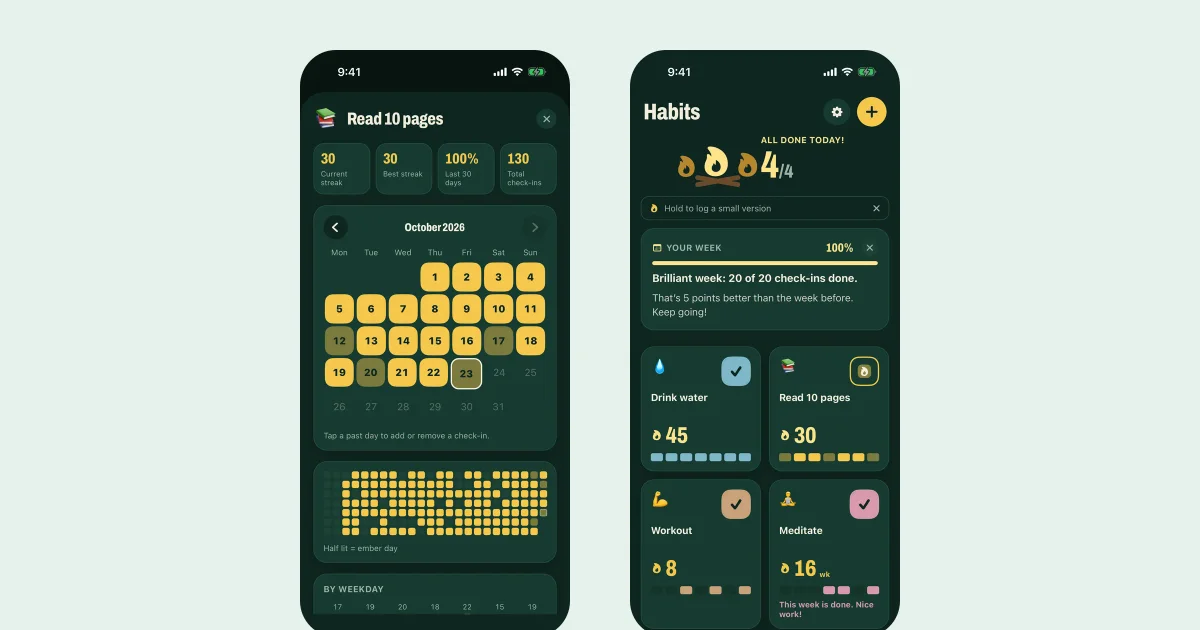
Streakfire is a habit tracker for iPhone: one tap checks in, each check-in fills a square in a grid, and rest days do not break your streak. Curious about a 21-day run? Treat it as your own experiment; the app only counts. See how to start tracking a habit and the Streakfire page.
Frequently asked questions
Where does the 21-day idea come from?
We did not find one reliable source for it, and it is repeated widely without one. Treat it as a rule of thumb rather than a finding; the study above is the research usually pointed to instead.
How long does it really take?
It varies. The study above found a range from 18 to 254 days. Your own pace is the only one that counts.
What if I miss a day?
Carry on the next day. In that study, a single missed day did not materially affect the process.
Does an app make a habit stick?
An app records what you do; the doing is yours. It can make progress visible, which many people find motivating.
Check in once a day and watch the grid fill
Streakfire shows each day you did it as a lit square, so you can see your progress at a glance.